
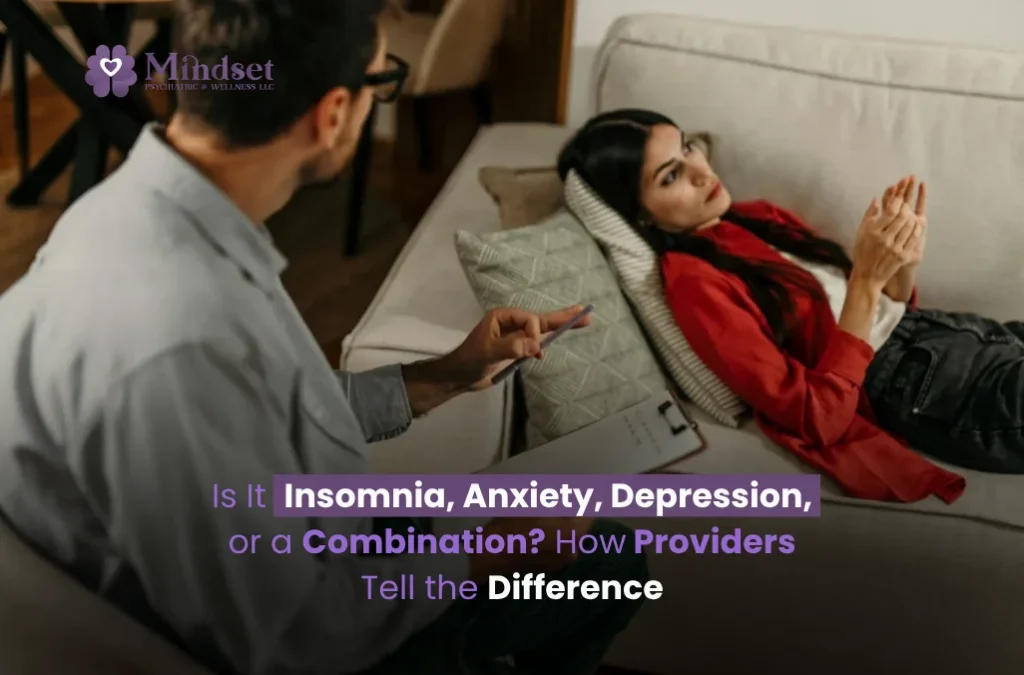
Picture this. It’s late at night, you have work in five hours, and your brain is busy replaying something awkward you said years ago. You call it insomnia and roll over.
Fair enough. It might be. But sleepless nights are sneaky, and a lot of the time there’s more behind them than bad sleep.
Anxiety can cause this. So can depression. Plenty of people have a mix.
If you’ve been wondering whether it’s insomnia, anxiety, depression, or some combination then you’re in good company.
Providers have to dig a bit to sort it out too, and they rarely go off a single symptom. They look at how everything fits together.
Why Insomnia, Anxiety, and Depression Are So Easy to Mix Up
Think about a rough day. You’re foggy, tired and short with people. Which condition does that point to? You can’t really say, because all three cause exactly that:
- Trouble concentrating
- Being worn out all day
- Snapping at people over little things
So someone with anxiety and someone with depression can describe their week in nearly the same words. Same goes for someone with plain old insomnia.
It gets messier because they push on each other. After a lousy night, tomorrow’s worries feel bigger and your mood just sinks lower.
And when you’re worried or down, sleep gets harder to come by. Round and round it goes.
Is It Insomnia, Anxiety, or Depression? Clues Providers Notice
A few patterns can give providers a hint. That’s all they are, though. Hints. None of them can diagnose anything alone.
When anxiety is in the mix.
Common signs include:
- A racing mind the second your head hits the pillow
- Feeling keyed up, like your body won’t power down
- Tight muscles, or a heart that seems to pound for no reason
- Worry that follows you around all day and just gets louder at night
Bedtime is when the distractions go away. Whatever you’ve been holding in finally has room to be heard.
There’s a flip side, too. After a run of bad nights, lots of people start to dread bedtime itself. Then they lie there worrying about not sleeping, which keeps them up. Providers see this often, and it’s a different thing from anxiety that’s there all day long.
When depression is in the mix.
Sleep can go sideways in a few ways. Some people can’t fall asleep. Some wake up again and again. Others open their eyes at 4 a.m., hours before the alarm, and can’t get back under.
That early waking gets linked with depression more than with the other two. But plenty of people wake early for other reasons, so providers don’t lean on it by itself.
Depression also tends to spill past sleep. You might notice:
- Your appetite has shifted
- Concentrating feels like wading through mud
- You feel worthless
- Things you used to love don’t land anymore
Heaviness seems to be another common descriptor of it by people. Flat. Detached. It sounds more like being burdened, than wired.
What a good night does (and doesn’t) change.
This is the kind of thing providers like to ask more about: What do you feel when you finally sleep well?
When you have insomnia, one good night can make the next day. When you are depressed a good night may relieve it some, but the weariness and sting of hopelessness hang on. Worth mentioning to your provider.
How Providers Look at Your Overall Pattern of Symptoms
There’s no magic symptom. So a good evaluation is really a conversation about everything. Expect questions like:
- How you’re sleeping, whether that’s falling asleep, staying asleep, or waking too early, and how many nights a week
- How your mood is during the day and whether you still enjoy things
- Physical stuff – like muscle tension, a racing heart, or restlessness
- How long this has been going on, and whether it comes and goes
- How it’s affecting your work, your relationships and taking care of yourself
- Medications, health conditions, caffeine, alcohol and stress
- Whether more than one condition might be happening at once
The last of course is the most important. Insomnia, anxiety, and depression overlap all the time, and treating one alone can leave you still feeling lousy.
Looking things up online is fine for getting your bearings. It just can’t do what an evaluation does.
FAQs
Can anxiety cause insomnia?
Yes. Racing thoughts, a tense body and worry that builds at bedtime can all make it hard to fall asleep or stay asleep!
It works the other way too. Bad sleep can crank up anxiety so the two can keep feeding each other.
Can depression cause insomnia?
Yes. One of the hallmarks of depression too is a change in sleep! It may be in the form of staying awake too long and awakening during the night or getting up too early.
Providers often think of sleep and depression together because poor sleep can make depression harder to treat.
How do providers diagnose insomnia?
There’s no single test. Mostly it starts with a conversation about:
- Your sleep history and daily habits
- Your mood and any physical symptoms
- Medications or health conditions
- How long and how often, sleep has been a problem
Providers also consider whether anxiety, depression or another health issue could be playing a part.
Schedule an Evaluation
You don’t need to have it figured out before you call. That’s what the evaluation is for.
If you’re tired of lying awake, dragging through your days, and guessing at the reason, we’d like to help you.
At Mindset Psychiatric & Wellness we discuss your sleep, your mood, and what a day in life looks like so that your care plan covers it all, not just one piece.
Live in or near Everett, MA? Contact Mindset Psychiatric & Wellness to schedule an appointment.